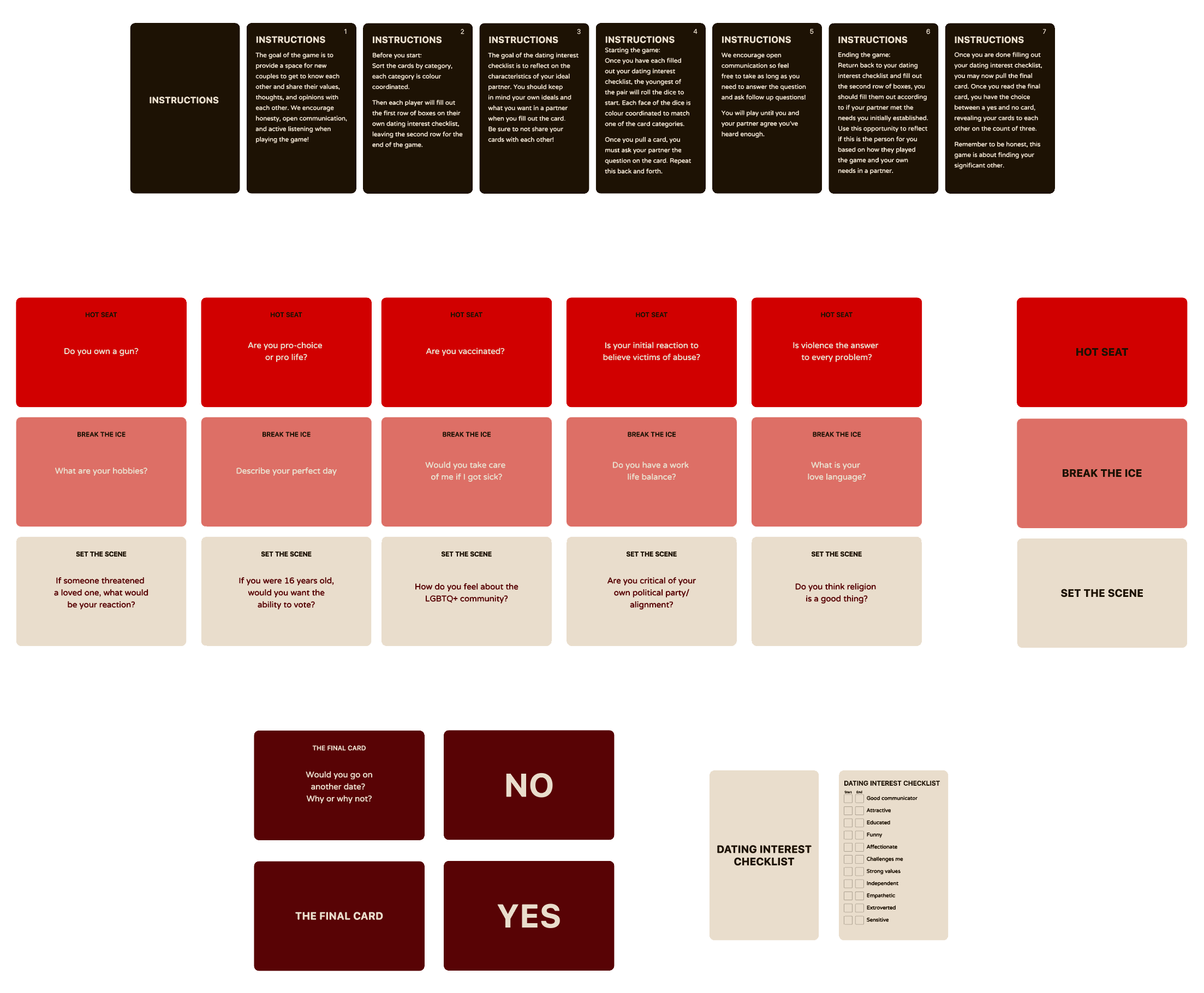
THE DATING GAME
This was a group project completed by Peri Agate, Victoria Collins, and Dev Dixit. This project reframes ideological polarization through the lens of dating, with the goal of opening communication between two individuals.
In dating, ideological polarization can play a major role in compatibility, when personal values or political views misalign it can cause uncomfortable feelings, confrontations to arise, and it may be seen as an overall dealbreaker. Let’s not waste time and get right to the point on the first date.
Background Research
Ideology is a recurring feature of human societies. Ideologies provide people with frameworks to evaluate the relative legitimacy of different approaches to social order. Such ideologies often involve an opposition between right-leaning ideologies, which tend to justify and maintain the traditional order, and left-leaning ideologies, which advocate for systemic reforms to reduce hierarchies (Eibach, 2021).
Political views are often a point of contention when finding a romantic partner. With research of how politics affect the process of finding a compatible partner, a partner's politics may not change the view of the other partner, political compatibility does play a role in partner compatibility (Klofstad, 2013).
With young adults in romantic relationships, partners may adjust to each other’s political interest, but when separations occurred, the influence of the former partner vanished. This is due to political discussions occurring frequently, increasing communication to either reinforce or oppose each other’s search for information about society; thus the increase of political interest of young adults and romantic partners playing a significant role in political interest (Stattin & Korol, 2021).
The Dating Game fulfills the need for a way to have conversation about politics and minimize ideological polarization from the beginning of the relationship.
Scenarios for Prototype Ideation
2024
Figma, Illustrator, & Zund Flatbed Cutter
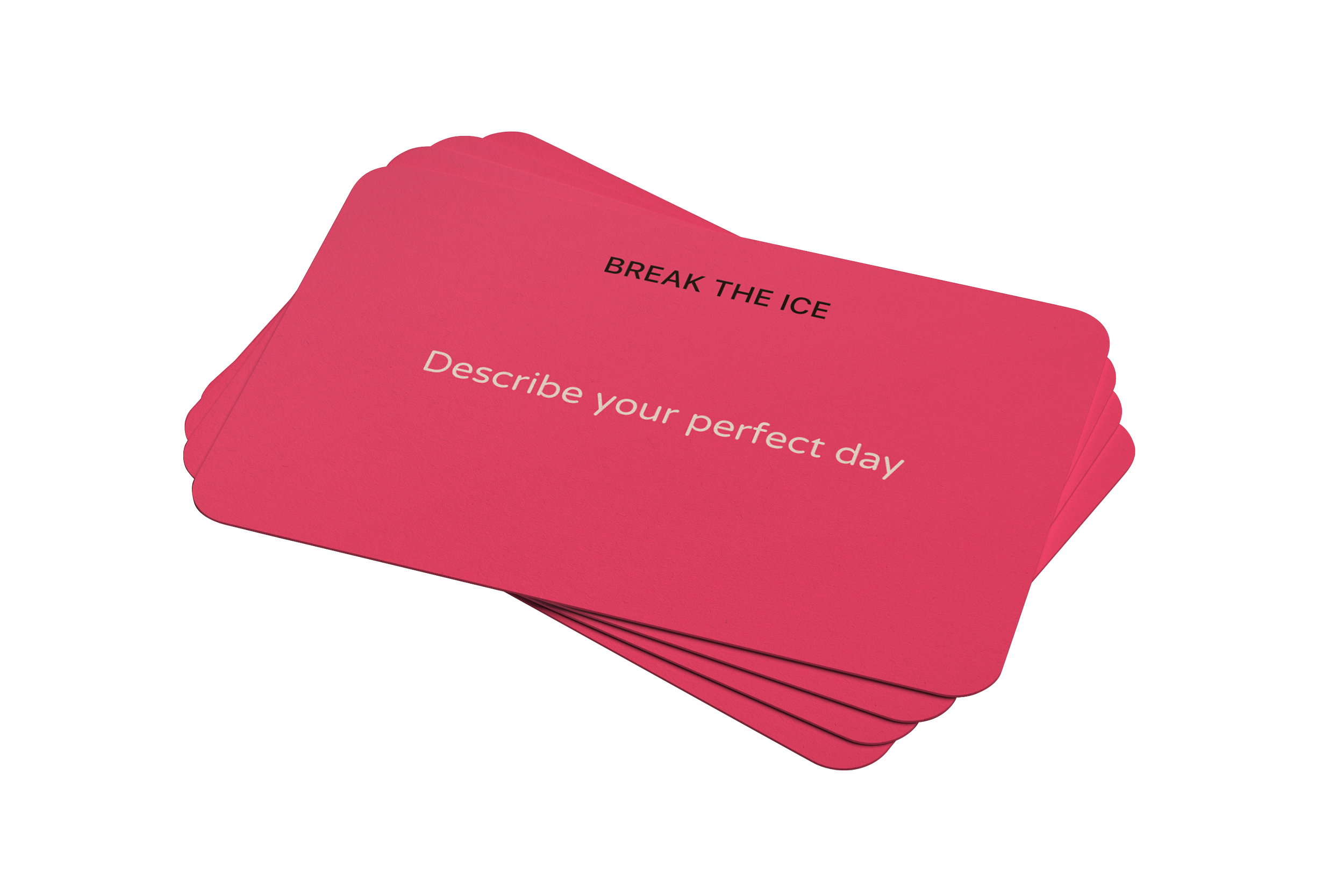
Beginning of game Scenario
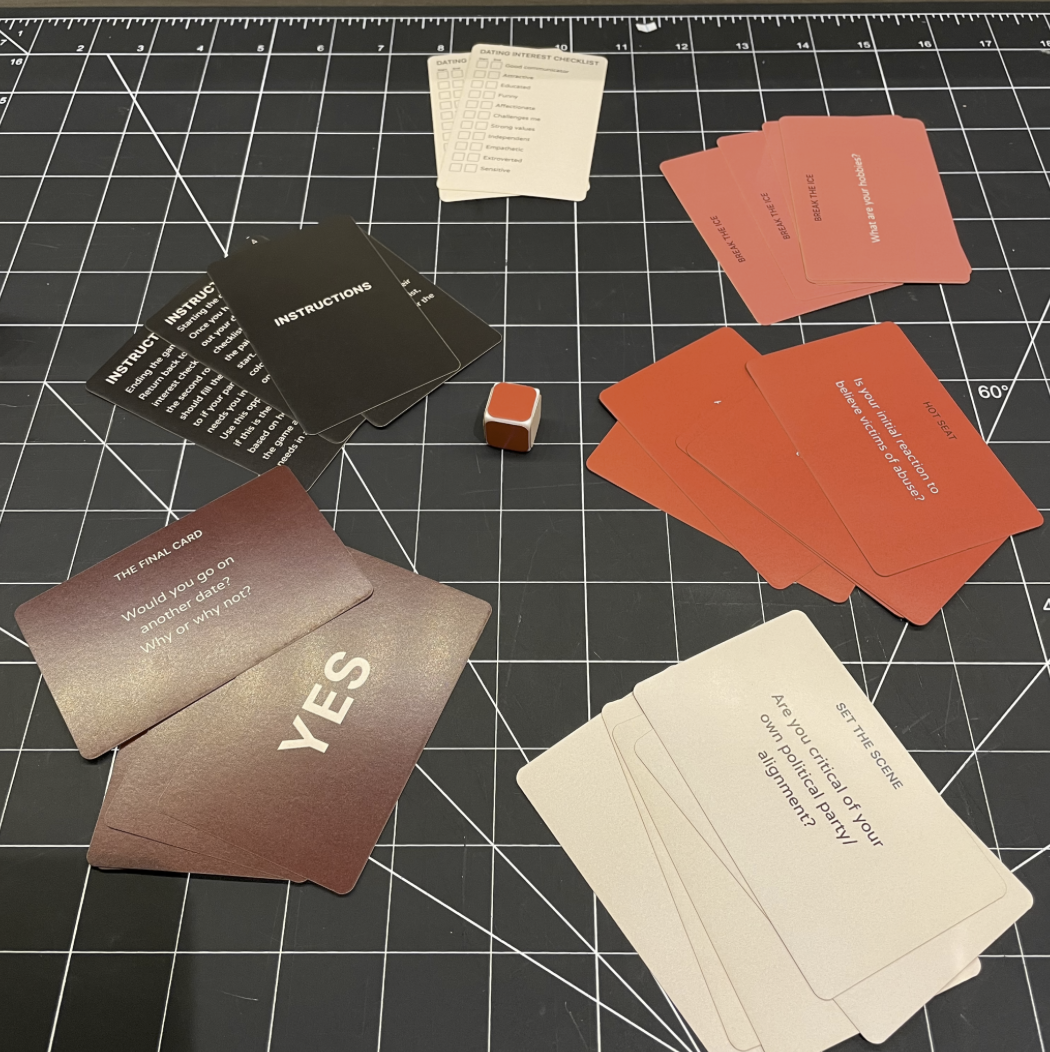
Two high school teens, Charlie and Harper go on a date at a games cafe. They decide to play the dating game to try and break the awkwardness of going on a first date and to get to know each other better. Since they have never played the game before, they start by reading the instruction manual, sorting the colourful cards by category, and then each filling out their initial checklist for what they look for in a partner called the dating interests checklist. The game then starts by the youngest of the group rolling the dice, and since Charlie is younger than Harper, they get to roll first. Each face of the dice is colour coordinated to one of the card categories, and Charlie ends up rolling the dating questions category. Charlie picks up the card and reads outloud “What are your hobbies?”. They both conversed about the question on the card, once done they discard the card in a separate pile. Harper then rolls the dice and draws a card from the Scenarios category. She reads the question “If someone threatened a loved one, what would be your reaction?” out loud and Charlie and Harper proceed to discuss. They are both enjoying this experience because it breaks the awkwardness of talking to each other on a first date and allows them to start this new possible relationship with open communication, helping them to realize talking to each other about their own interests, thoughts, and opinions is a good thing!
Full Game Play Scenario
Brittany and Bea have been set up on a blind date through some mutual friends. Bea brings along this game to see if they truly are as good of a match as their friends think they are. They start the game by individually filling out their dating interests checklist before rolling the dice and picking up cards to start the conversation. After a couple of rounds Brittany and Bea start to realize that they agree on most topics, have the same deal breakers such as being non-smokers, and there are some topics such as elections, where they have the opportunity to share their views and even educate each other in a productive and respectful manner. After they have been playing for just over an hour, it is time to revisit their dating interests checklist. When revisiting their dating interests checklist they are able to compare if their dating needs they stated at the beginning of the game can be fulfilled by one another. Brittany and Bea then move on to conclude the game with the “Would you go on another date? Why or why not?” card, they both write yes on their provided blank cards. Turns out they agree on a lot and both see a future with each other.
Group Game Play Scenario
Jamie is planning to host a double date with her new partner Richard, and friends Violet and Sid. Jamie is new to dating and has only now been introduced to her first serious relationship. Jamie and Richard have only been going out for 2 months, so the relationship is still pretty fresh. The two met on an online dating site, and believed their profiles matched so well that they started dating after the third date. As for Violet and Sid, they have been going out for a while, and have both been close friends with Jamie since high school. Jamie has a lineup of games prepared for the night, one of them being The Dating Game. The group thinks this will be a fun way to get to know Richard as he is pretty new to the group. As the game goes on, and the group reaches deal breaker questions, Jamie starts to notice that she and her partner Richard do not have the same views. This causes confusion for Jamie, as the partner she has been dating for the last 2 months is seemingly not the person she thought she knew everything about. Jamie learned that these questions are valuable to her when deciding who to date. Going forward she will proceed with making sure these topics arise in conversation before committing to a relationship.
User Testing Sessions
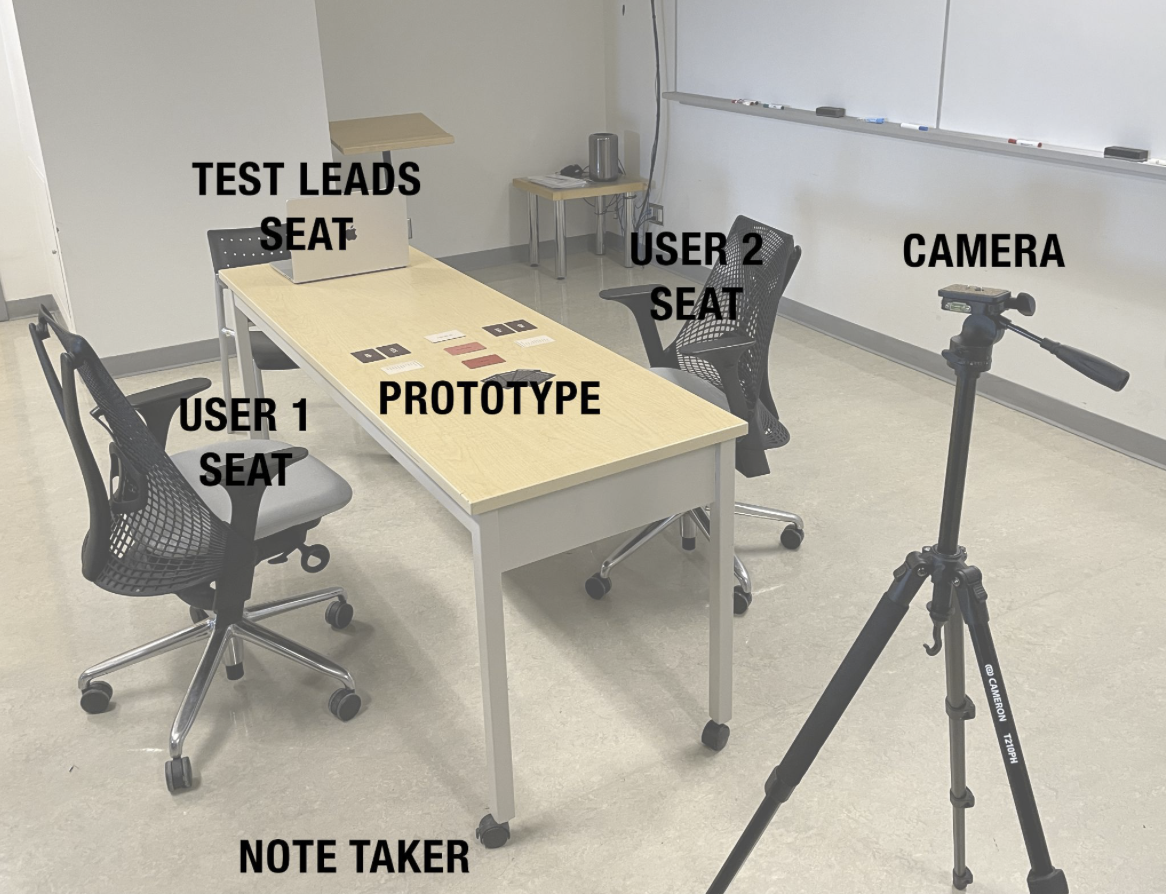
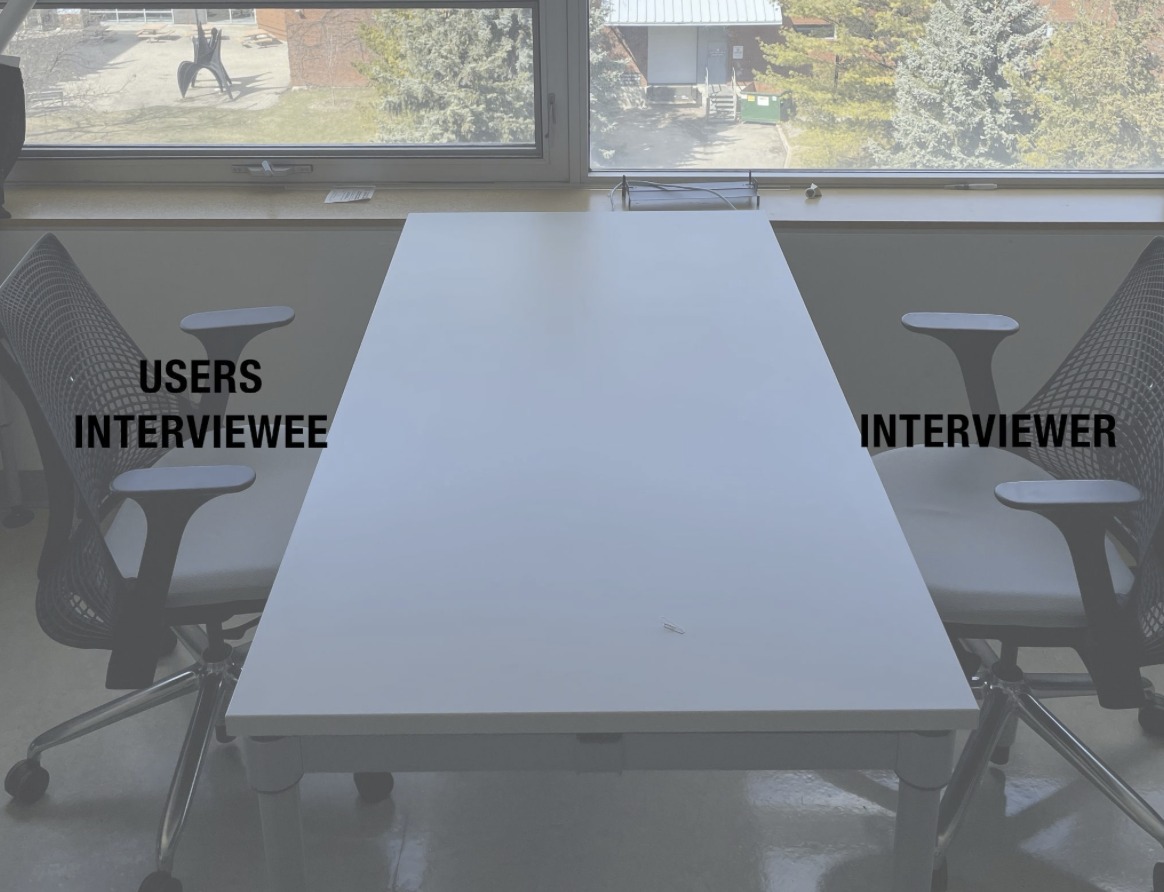
Testing Procedure
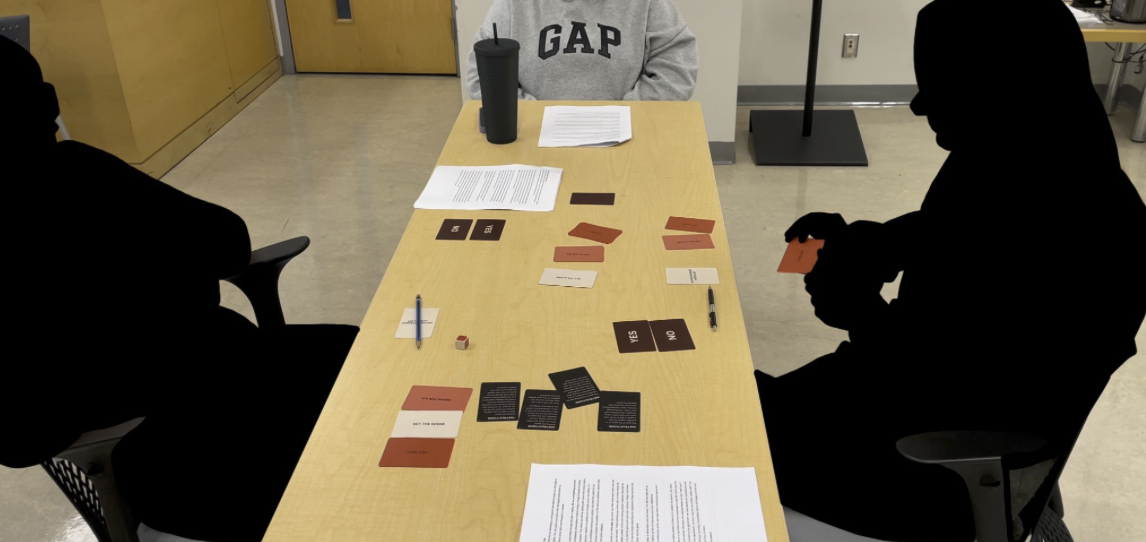
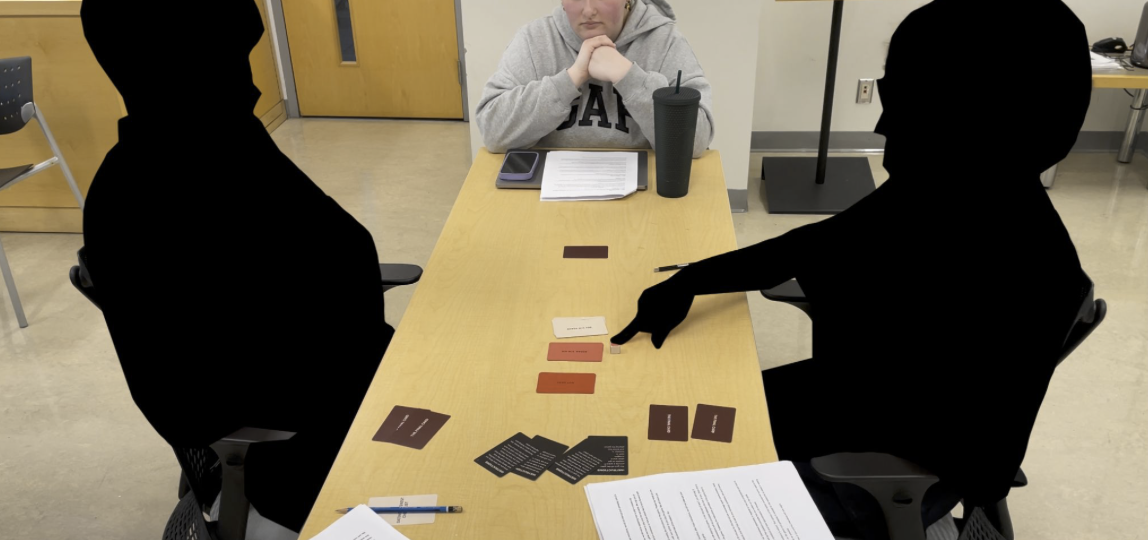
Overall the testing procedure was very successful. We conducted two separate user testing sessions, each with two user testers. The reasoning for this was because our test was for a card game to test compatibility between partners and their personal beliefs and values. I was the main moderator for the actual testing, I read the test scripts and initiated and concluded every test. Dev and Victoria observed and took notes as the tests were conducted.
I was surprised at how smooth and natural the actual testing felt. The whole process from start to finish ended up taking less than an hour per test and the tests flowed seamlessly into each other making the whole process enjoyable for everyone. The biggest challenge was preparing for the testing. I was away when the prototype was being printed and there ended up being some printing errors that I do think ended up affecting the testing somewhat, despite this there were no major challenges that hindered the testing process and experience. My expectations for the testing were definitely met, especially since the testing was smooth and relatively easy to conduct, making it a low stress experience.
Findings
Although it was originally discouraged for our test to include a fully designed prototype, I felt it was important for us to have our branding and colour scheme created and applied to the prototype before the user testing sessions. The reason I felt this was so important is because the atmosphere the branding can provide felt crucial for something as intense and thought provoking as our card game. I am very happy that we did end up creating and applying our branding to our prototype because some of the major feedback we received was about the colours we picked, how they helped set the mood, and how some colours affected the gameplay itself. I also reaffirmed how important it is to be organized and talk through all the small details and think about all the possible ways the users will interact with the prototype. I feel like a major reason why the user testing went so smoothly was because we tried really hard to look at the prototype from all different angles and talk through what we felt would be the most realistic response to our designs.
Analysis
One of the biggest design implications was definitely the colour palette for the Hot Seat and Break The Ice categories. When printed, the bold red and the darker pink were too similar when printed on the dice, making it a challenge for the user testers to distinguish the colours which ultimately caused confusion but didn’t necessarily disrupt the gameplay too much. This is a very easy fix by lightning the shade of pink that was used so it is more easily distinguishable especially when printed on a smaller surface such as the dice.
The other major design implication was the double sided instruction cards. During our first round of user testing it took the users almost seven minutes to realize that the instructions were double sided despite them being numbered, it also took our second of user testers a few minutes to realize that the instructions were double sided. Our initial intent for the double sided instruction cards was so the users had less physical cards to get through, hopefully making the instructions seem less daunting, however, it instead left the users confused. This was a major red flag for us and we all agreed moving forward we would switch to single sided printed instructions that are still numbered so there is far less confusion.
For the future, not only do I think making the two changes I already stated is a good start, but I would also love to test group style gameplay. Due to time restraints and testing limitations, we decided to focus on solely couple style gameplay, however, we did have in mind a group style gameplay for the future and it was also mentioned a few times in the user testing interviews that it would be a fun game to play with a group of friends or with family. If we did create a group style gameplay, it would be smart to eliminate the dating aspect and shift it more to moral compatibility.
Reflection
The user input challenged my assumptions about how long the game play would last and if people would actually feel encouraged to play. During the testing, the conversations that lasted the longest or seemed the most controversial were definitely topics of religion and being critical of politics. In both user tests, the users agreed with their partner so during the test we did not get to observe any sort of dispute or argument because of disagreement on a topic. Because of this, I do believe that the conversations between partners were shorter because they agreed on topics, and my assumption would be that conversations where partners disagree would last longer because there would be more of a back and forth conversation/argument. However, my next assumption would be that the Break The Ice category would spark more conversation between partners who are compatible and less conversation between partners who are not compatible.
The entire process of the user testing was very smooth, but if I were to change anything for next time I think finding user testers who have never met before would be extremely interesting to observe and would be very telling about the success of the game itself. Overall this entire user testing process was very educational and I learned a lot about how to properly test users and use it to your advantage when designing. This was my first time conducting user testing and I feel really confident moving forward, and if I had to change anything, the only thing I would change is making sure the user testers do not know each other or have very limited knowledge of each other for at least one of the tests.
Full User Testing Plan & Report